
Mapping Border Killings
No More Deaths publishes first comprehensive database of recovered human remains for the US-Mexico border

“Border deaths are presented as passive occurrences, as if people just happen to die, as if there’s something inherently dangerous about being on the move, which we know is not the case. Many people move with immense privilege, even luxury. It’s more accurate to call what is happening to migrants and refugees around the world border killings.” -Harsha Walia
The Palestine-Mexico Border
When I go to sleep, I think of Gaza. When I wake up, I think of Gaza. When I eat, I think of Gaza. When my children eat—then, most of all—I think of Gaza. To think or write about anything else in this moment, as two million people starve and die and we watch it in helpless horror on our phones, feels wrong and insane. To go on with daily life feels wrong and insane. And yet, here we are, on a planet pulled to pieces by a thousand crises, each spiraling into the next.
And that, of course, is the thing: every crisis is related. If this wasn’t painfully clear already, Gaza makes it excruciatingly obvious. “The Palestinian condition is the human condition,” writes Mohammed El-Kurd. “The lens we lend the Palestinian reveals how we see each other, how we see everything else.” The death of Gaza is the death of humanity. Our only remedy: resistance.
When I think of Gaza, I think of the US border—that other apartheid wall, one of many—where these connections manifest in acutely material ways. For example: much of the dystopian technology deployed to terrorize asylum seekers and the undocumented comes from Israel or was tested on Palestinians. Elbit Systems, Israel’s largest weapons manufacturer and the company that supplies 85 percent of the Zionist regime’s land-based military equipment and the same percentage of its drones, as well as the tools that control the West Bank separation barrier and Gaza’s “Iron Wall,” also builds the surveillance towers that dot the grass and mesquite hills of southern Arizona like panoptic Tinkertoys, pushing migrants into deadlier terrain. Frontex, the European Union’s border patrol, likewise relies on Israeli-made drones and cell-signal surveillance to monitor refugees and migrants in the Mediterranean and push them back to Africa to be tortured and enslaved, or to drown and disappear at sea.
Elbit, which receives billions in US government contracts and benefits handsomely from US aid to Israel, proudly markets its killing machines as “battle-tested” on Palestinians: the Hermes drone, used to murder civilians in Gaza for decades; the “Iron Sting” GPS and laser-guided mortar system; the AI-powered “Iron Fist” gun turret mounted to Israeli tanks and bulldozers; and so on. Meanwhile, the US military contractor Raytheon, which provides missiles and other ordnance to massacre Palestinians, supplies the surveillance and “less-than-lethal” weapons that Border Patrol uses to hunt migrants in the desert and that police and ICE agents—trained, in many cases, by Israeli security forces—rely on to target immigrants and repress protestors in US cities.
Palestine is a laboratory for this death-dealing technology—the border, its secondary testing ground.
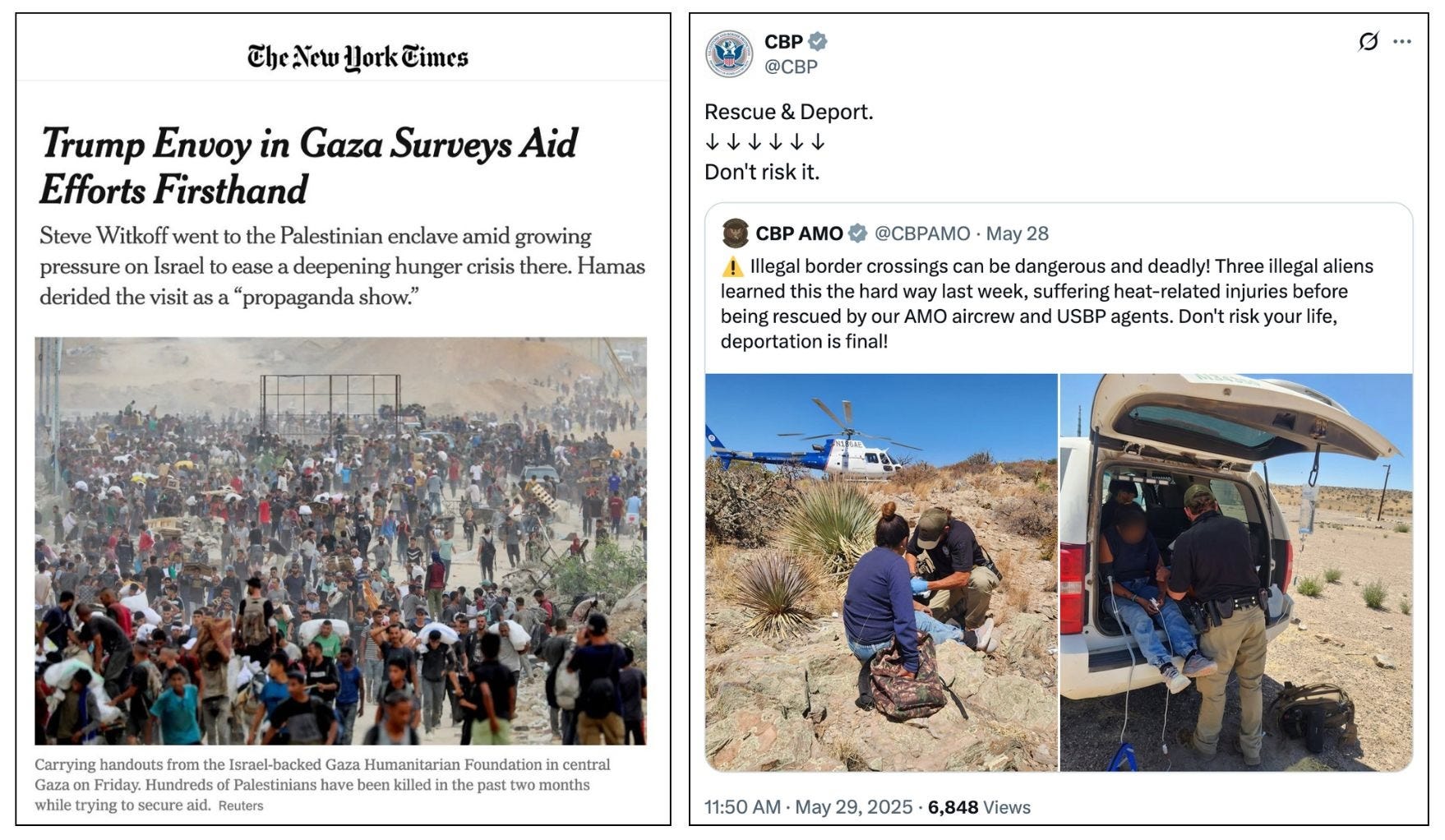
Meanwhile, as Trump follows in the footsteps of Biden’s $320 million “aid” pier PR stunt, telling the former genocider-in-chief to hold his beer as he deploys “humanitarian” traps to lure desperate Palestinians to their deaths, I am reminded of Border Patrol’s insistence that its agents are life-saving humanitarians who “rescue” migrants from the death traps the agency sets for them. The scale and intensity of the murderous cruelty in Gaza is unmatched by anything at the US border, of course—but the logic is essentially the same: “humanitarianism” as a weapon, and as subterfuge for crimes against humanity.
New Report and Map from No More Deaths
In the shadow of the genocide perpetrated by Israel and its allies in Gaza, this week, I want to turn back to the border (expanding on a post I wrote last month) to highlight an important new resource published today by the migrant solidarity project No More Deaths (NMD): a comprehensive database and map of recovered human remains for the entire US/Mexico land border.1
This is a crucial resource that, until now, did not exist. The organization Humane Borders has long maintained a searchable map and database of recovered remains for the state of Arizona, and other NGOs and media occasionally publish statistics on migrant deaths, as does the Department of Homeland Security, but until now, reporters and advocates have had to patch these incomplete sources together to find information on individuals or identify larger trends.
Because the crisis of death at the border is also, by design, a crisis of disappearance, no database, map, or report can ever fully document the true scale of its lethality—to say nothing of its many other cruelties. As the authors state in the report’s opening paragraph: “This data will not bring anyone back or undo the decades of suffering and death caused by United States border policy and perpetrated by the US Border Patrol, and it does not account for the tens of thousands lost or missing in the borderlands—but it does provide the most comprehensive statistical record to date of people who died on their journey into the United States.”
This new database, which includes human remains recovered from the southern US borderlands from 2002 to present, compiles data from several sources, including medical examiners, coroners, justices of the peace, and sheriff’s departments, and compares these statistics with Customs and Border Protection (CBP) and Border Patrol’s notoriously flawed datasets.
You can read the full report here. Below are some of its key findings:
Border Patrol and CBP significantly undercount migrant deaths
Border Patrol and CBP are infamous for undercounting the deaths caused by their own policies and enforcement actions. NMD’s new report confirms and provides more details about this well-documented practice, showing that these agencies massively undercount migrant deaths especially when people die in their custody, during apprehension, or as the direct result of their infrastructure (i.e., falls from the border wall).
“Depending on the [Border Patrol] sector under analysis, we document anywhere from 20% to 40% more migrant deaths than CBP’s official count,” the report reads. “For Yuma, San Diego, and El Paso sectors, we counted 21 deaths in custody, while the OPR [Office of Professional Responsibility, tasked with reporting agency-involved deaths] reported only 3; 87 deaths due to falls from the border wall, while the OPR reported only 17; 81 deaths due to medical distress in cases involving USBP, compared to 34 reported by OPR; 68 deaths due to USBP pursuit by vehicle or on foot, of which only 13 were reported by OPR; and 8 cases in which a migrant was killed by USBP’s use of force, of which none were reported by OPR.”
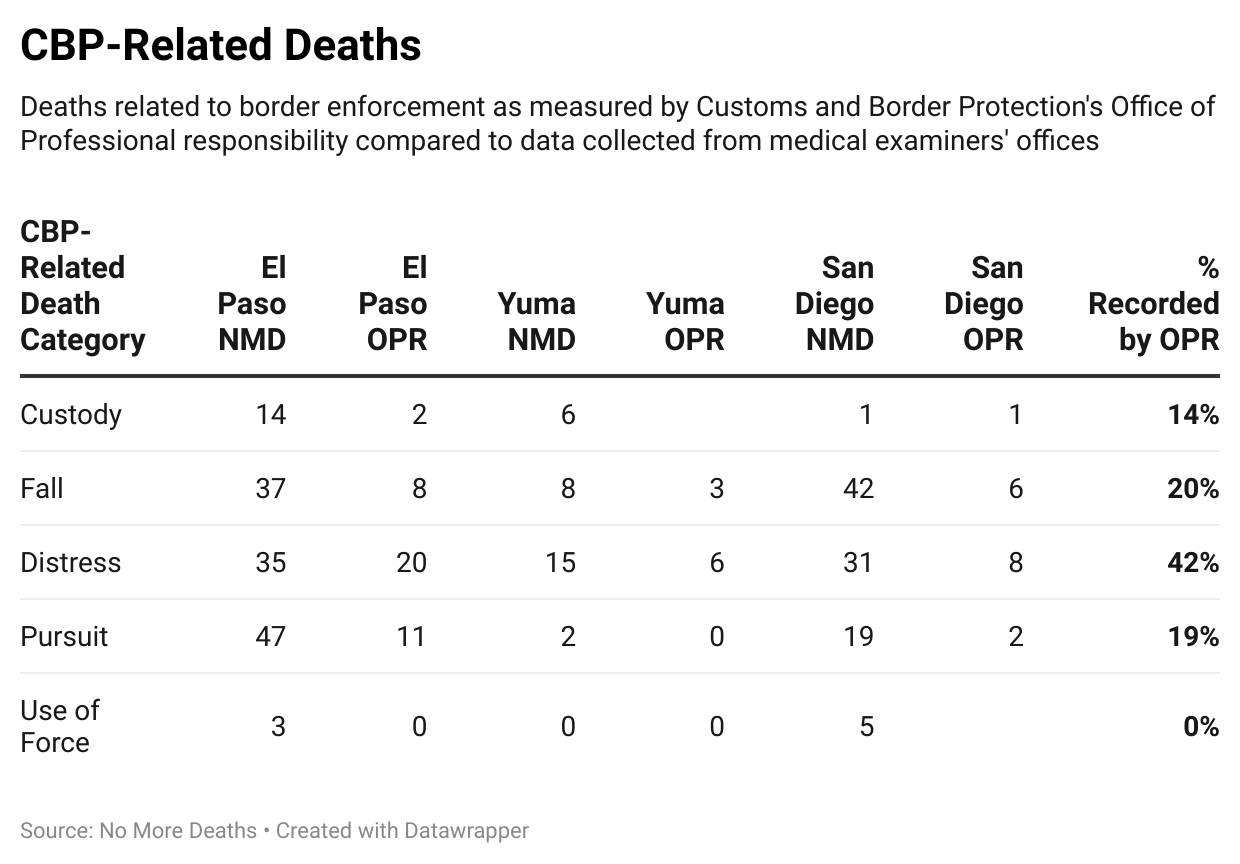
These numbers, of course, are only the tip of the iceberg: many more people have been killed by the border and scores more have been injured or permanently disabled. Not to mention families torn apart, children and communities terrorized, daily acts of racist dehumanization, and an endless litany of abuses that grows longer by the day.
Border Patrol and CBP misreport identifying information of victims
Border enforcement agencies also misreport key identifying details about victims, such as name, age, nationality, and date of death. In some cases, the agencies even misreport cause of death—especially in cases where agents or border infrastructure are directly implicated.
Some of these errors are likely the result of negligence—a negligence that reflects the dehumanization of migrants structured into the culture of Border Patrol—but according to NMD, deaths directly caused by enforcement or the wall “are often miscategorized in a way that is difficult to interpret as anything but intentional.” For example, “causes of death are changed to ‘exposure’ or even ‘medical examiner undetermined’ when the medical examiner had very clearly attributed the cause of death to a fall from the border barrier.”
This practice fuels the crisis of disappearance: By denying family members accurate information on their missing loved ones, Border Patrol ensures that many relatives are never notified of their deaths, leaving families in limbo and “raising serious questions about the integrity of in-custody death reporting and the possibility of state-sponsored enforced disappearance.”
Increase in deaths of asylum seekers and US residents
Over the last ten years, the US government has steadily eroded access to asylum, exacerbating the crisis of death, disappearance, and suffering on both sides of the border. While information proving that a person was seeking asylum when they died is difficult to obtain, NMD’s dataset shows an increase in deaths of individuals who are more likely to be seeking asylum (i.e., people from West Africa, South Asia, and South America).
Data on US residency status is also difficult to obtain, but in areas where these details are available, such as San Diego, NMD found evidence that many US residents had died while attempting to cross back into the country. These ranged from people who had traveled to Mexico to visit family and had to make a difficult crossing to return home, to people who died after a recent deportation to a place where they likely had few or no connections. In some cases, family members of the person who died were forced to search for their missing relative themselves, after Border Patrol refused to initiate a timely search—a common practice, as documented in another report published by NMD in 2021.2
“With the Trump administration’s attempts to block any access to asylum at the southern US border, we are sure to see increases in deaths of more vulnerable populations, as well as harder to quantify consequences for people unable to flee dangerous situations in their home countries, or stuck in perilous circumstances in a third country,” the report reads.
You can read the full report and access the map and database here. And if you can, please donate to support the life-saving work of No More Deaths:
That’s all for now. Here are a few things I’ve been reading, related to the stuff above:
A recent story in Rolling Stone by Lillian Perlmutter, about Ada Guadalupe López Montoya, a woman who fled the US-backed Bukele dictatorship in El Salvador and died in the desert in New Mexico. The story draws on a recent report by No More Death documenting the increase in migrant deaths in the El Paso area.
Brandon Shimoda’s latest essay in The Baffler: “Alien Enemies: Japanese American incarceration’s ghastly redux.”
Mary Turfah’s intervention for Parapraxis, on the moral limits of raising awareness—an essay, titled "Complicity,” in which she asks: “Who is it for, I’ve wondered, the ‘after they’re done with them, they’ll come for you’? Who looks at a Palestinian child and needs to hear that theirs could be next?”
Paul Ingram’s report on the militarization of the Cabeza Prieta Wildlife Refuge along the Arizona/Sonora border, roughly one third of which is now under the control of the Pentagon. Trump is ceding public land along the southern border to the military in an effort to further criminalize migration: by designating border areas as DOD property, migrants can be charged with criminal trespassing.
Sally Hayden’s reporting from occupied Palestine, especially this disturbing story about Israeli genocide tourism: “From a viewing platform in Israel, observers watch Gaza’s destruction through binoculars.”
Heba Almaqadma’s dispatch from Gaza for Drop Site News, on Israel’s “minutely engineered” campaign of mass starvation. “[Palestinians] do not need pity,” she writes. “We need pressure on those who are blocking food, those who remain silent, and those who still have the power to stop this but choose not to.”
The “border,” as I mean it here, is not a distinct line delineating Mexico from the United States, but a vast enforcement area extending over a hundred miles north into the interior of the country.
I had to send this to my email account so I could read it all. Particularly chapter 4, on how 911 calls are treated if they come from undocumented people.
Reminds of the book “The Land of Open Graves”, but much more complete. So incredibly sad! Why doesn’t this get more attention by the press.
Look forward to reading this, Max.